When businesses think about rising server costs, they often focus on the full system price. But the real pressure may be hiding inside the server itself.
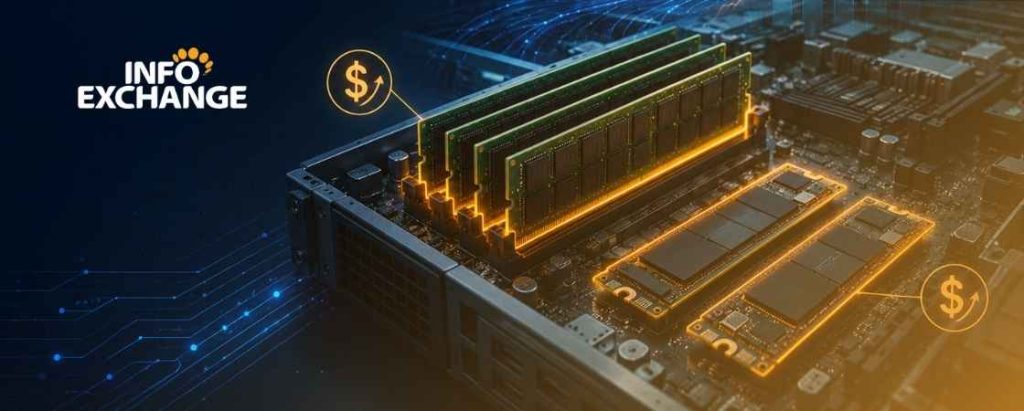
RAM and NVMe (Non-Volatile Memory Express) storage are becoming two of the most important cost drivers in enterprise infrastructure. They affect speed, capacity, performance, backup, recovery, and the ability to support growing workloads. As AI data centers continue consuming more memory and high-performance storage, traditional businesses may feel the impact when planning upgrades of their own.
This is why RAM and NVMe can no longer be treated as simple add-ons. They now deserve a closer look in every infrastructure budget.
Why RAM Is Getting More Expensive
RAM is one of the most important parts of modern server infrastructure. It supports virtualization, databases, analytics, backup systems, business applications, and other workloads that need fast access to data.
The challenge is that AI systems also need large amounts of memory, especially advanced memory used in high-performance computing environments. As manufacturers focus more capacity on AI-related demand, traditional enterprise server memory is now competing in a tighter market.
Network World, citing Counterpoint Research, reported that DDR5 server memory prices could double by 2026 as manufacturers shift capacity toward AI chips and memory-intensive AI server platforms. (Network World)
For businesses, this means a server upgrade may not simply cost a little more. It may require a serious budget review, especially if the environment depends heavily on RAM to support growth, performance, or critical applications.
NVMe Storage Is Under Pressure Too
NVMe SSDs are popular in enterprise environments because they deliver fast performance for demanding workloads. They are commonly used for databases, virtual machines, analytics, backup acceleration, and applications that cannot afford slow storage response times.
But AI data centers are also hungry for high-performance SSDs. They need fast storage to move, process, and retrieve large volumes of data at scale. That rising demand is creating more pressure on enterprise SSD supply.
TrendForce reported that demand for high-performance SSDs has grown significantly as generative AI moves into large-scale adoption. The firm also expects a clear enterprise SSD shortage in 2026, with meaningful capacity expansion unlikely until late 2027 or 2028. (TrendForce)
That is a warning sign for businesses planning storage upgrades. If demand continues to rise and supply remains tight, pricing and availability may become harder to predict.
Where the Hidden Cost Shows Up
The hidden cost is not only in the purchase price. It shows up in the decisions businesses may be forced to make.
A company may delay a server refresh because RAM costs more than expected. A storage upgrade may be scaled back even though performance demands are increasing. Backup and recovery plans may become more expensive as data volumes grow. Modernization projects may also need to be reworked because the original hardware budget no longer fits the market.
Before approving the next server or storage purchase, IT leaders should review:
- Which workloads truly need more memory
- Which systems require NVMe-level performance
- Where tiered storage can help control cost
- How storage growth affects backup and recovery
- Whether procurement should begin earlier
Gartner estimates that combined DRAM and SSD prices could rise by 130% by the end of 2026, creating wider cost pressure across business technology purchases. (Gartner)
The Bottom Line
RAM and NVMe price inflation is a quiet but serious planning issue. Businesses that understand where these costs show up will be better prepared to protect performance, manage budgets, and avoid rushed infrastructure decisions.
Info Exchange helps organizations review their infrastructure, identify upgrade priorities, and plan smarter technology investments. If your servers or storage systems are due for review, now is the time to start the conversation.