


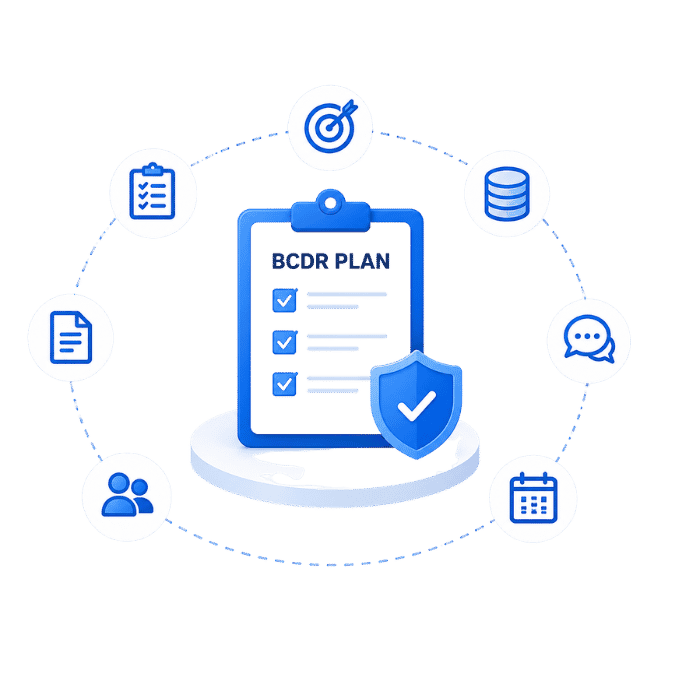

BCDR Testing: Why Most Disaster Recovery Plans Fail
Ask most organizations whether they have a BCDR plan, and the answer is yes. Ask whether it's been tested, and the answer gets complicated. Around only one in three organizations test their disaster…

Business Impact Analysis: How to Get Started (BIA Guide)
The Business Impact Analysis is the part of BCDR planning that most organizations either skip entirely or treat as a checkbox exercise. That's a mistake, and it's usually the reason recovery plans fall…

Building a BCDR Plan: The Core Components
Let’s be honest, a BCDR plan is only useful if your team can use it when things get messy. It is one thing to say the business has a plan, but it is…

How BCDR Protects Your Business and Builds Client Confidence
Business continuity and disaster recovery planning is often viewed as a safeguard, something put in place to prevent problems from becoming catastrophic when disruptions occur. That framing is accurate, but it is incomplete. …
After Hurricane Melissa: Eliminate Single Points of Failure Before They Eliminate You
To eliminate single points of failure, identify critical dependencies, provide independent alternatives, and test your recovery procedures. A single point of failure is a component or dependency whose failure stops a critical service…

After Hurricane Melissa: Stop Treating BIA Like a Checkbox
A Business Impact Analysis, or BIA, should tell you which business functions need to recover first, how long your organization can operate without them, and what the impact will be if they stay…
Is Your IT Ready for the Challenges of Tomorrow?
The future is closer than you think, and your IT could be the difference between staying ahead or playing catch-up. Technology is moving faster than ever, creating amazing opportunities while introducing challenges no…

How to Recover Fast from Human Error
Human error is one of the most common causes of operational disruptions for businesses globally. From accidentally deleting critical files to clicking on phishing links, small mistakes can lead to big consequences. Did…

Avoiding Downtime: Lessons from Resilient Businesses
We hope you haven’t been in a situation where everything just… stops. Systems crash, data disappears, and your entire operation feels like it’s stuck in quicksand. It’s frustrating, costly, and downright stressful. We…

6 Features of a Resilient Backup Solution
In today’s fast-moving digital world, your backup solution needs to be as tough as the tech it supports. Data loss can hit from all sides—cyberattacks, hardware failures, even natural disasters. The cost of…

Essential Steps for Implementing Immutable Failsafe Backups
Worried about the safety of your backed-up data? We’ve all been there. The good news is, you can take control. Imagine having a backup system so secure that even the most relentless cyber…
Immutable Backups: The Ultimate Shield for Your Data
Imagine enjoying a quiet evening when, suddenly, your phone alerts you to a major issue at work—it could be a data breach, a ransomware attack, or even system failure. It’s a chilling thought,…

Application-Centric Recovery: The Strategic Shield for Business Continuity
The success of your organization relies on the uninterrupted flow of its operations. If you are running a business, you should already understand that data protection is a critical component of any company’s…

Simplifying Data & Application Recovery for Complex Systems
Maintaining a business's IT infrastructure in today's environment can pose significant challenges. If you oversee IT operations, it's fair to assert that you will inevitably encounter system disruptions, whether they result from hacking…

Design Your Organization to Withstand Future Disasters
Author: Juliette Kayyem | Published by: c.2022 Harvard Business School Publishing Corp. There's a tremendous focus on leadership, communication, and planning in the business literature about crisis and disaster management. Security teams…

Make Resilience Your Company’s Strategic Advantage
Article Written By: Martin Reeves, Annelies O’Dea and Philipp Carlsson-Szlezak Over the last few years, business leaders have been reminded repeatedly of the interconnectedness and unpredictability of businesses, economies, and societies. Humanitarian disasters,…

Knowing Your RTO & RPO Could Save Your Company $Millions
You don’t have to know everything about how your IT plan for disaster recovery works. But there are two critical metrics related to that plan that should be clearly defined before you sign-off…

Business IT Resilience: Beyond Disaster Recovery
The pandemic has accelerated the pace of digital transformation in society. But in today's world, is backup and recovery enough? Mobile connectivity and Social media have created a hungry monster that businesses are…